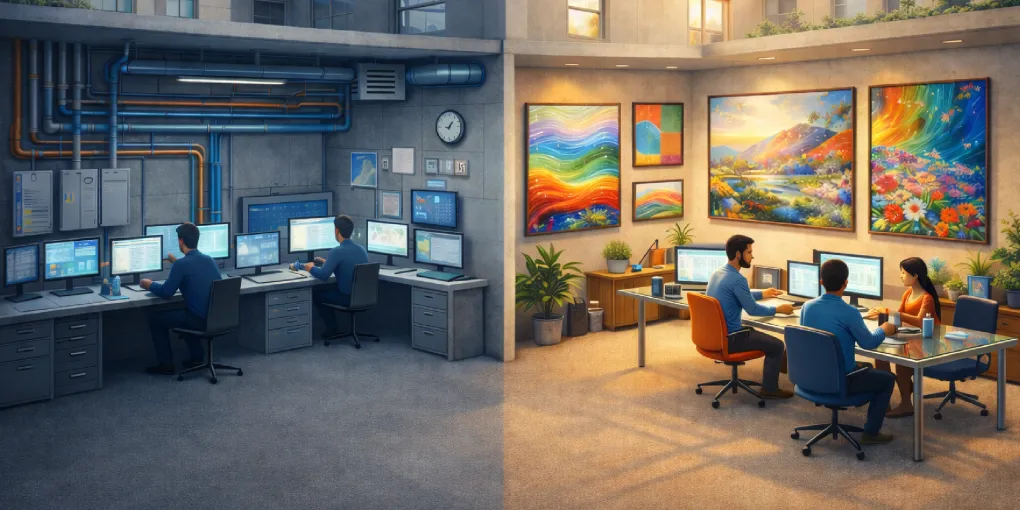
Art as Infrastructure
Beyond Decoration
In 1989, Harlem Valley Psychiatric Center in New York implemented an environmental redesign that included visual art, updated color palettes, and spatial improvements. The result: almost a 50% reduction in patient violence, better engagement in therapy, and significant improvements in staff morale.
What if art were not an aesthetic luxury but a functional necessity? What if it had the same status as lighting, ventilation, or spatial design in our environments?
More recent studies support that direction. Art making produces measurable reductions in cortisol, the stress hormone, regardless of previous artistic experience. Viewing art lowers blood pressure. Regular contact with art strengthens neural networks associated with psychological resilience.
This is not just rhetorical. A growing body of scientific evidence suggests art can function as infrastructure for human wellbeing, not as ornament, but as a foundational support system.
Infrastructure or Decoration?
Art as decoration is often treated as optional, secondary to the “real” function of a space. It is something that makes a space look good, but not something that makes it function better. In that frame, art is a luxury: nice, but expendable.
Infrastructure, on the other hand, is essential, functional, structural. It is what allows a system to operate. We think of roads, electricity, and clean water as infrastructure: systems without which modern life cannot function.
In this article, we invite readers to consider art under that second category: not as the final aesthetic touch, but as an essential component of any space. Through this lens, art as wellbeing infrastructure:
- Performs measurable and specific functions: it does not just look good, it reduces physiological stress, improves cognition, and supports emotional regulation.
- Has observable consequences when absent: spaces without art produce more cognitive fatigue, disorientation, and social isolation.
- Improves multiple systems simultaneously: at the individual level it supports resilience, at the social level it supports cohesion, and at the organizational level it improves productivity and talent retention.
Think about lighting. We do not ask, “Can we afford electric light in this building?” We ask, “What lighting setup optimizes how this space functions?” Art, treated as infrastructure, deserves the same framing.
When we view art this way, the question shifts from “Can we afford to invest in art?” to “Can we afford not to?”
Evidence: A Healthcare Case
If art functions as wellbeing infrastructure, we should be able to measure it, especially in settings where wellbeing is the core objective. Hospitals and mental health facilities provide exactly that testbed.
A recent study led by TurningArt with Yale School of Medicine examined art impact across 40 mental health institutions in the United States, covering 17 states and multiple facility types (hospitals, outpatient clinics, community centers, private practices).1 Ninety-three mental health professionals were surveyed about art impact on both patients and staff.
Findings were notable:
Measurable Outcomes in Patients
- 97% of staff rated artistic interventions as “valuable” or “very valuable”
- Observable stress reduction (average: 4.33/5)
- Improved emotional regulation (69% of cases)
- Higher therapeutic participation (56%)
- Better social interaction (66% in communication, 53% in relationships with staff)
The Most Important Finding
The most revealing pattern was not which type of art worked best, but who had access. Institutions that offered arts programming for both patients and staff performed better across nearly every metric, significantly outperforming institutions that offered it only to one group.
This suggests something crucial: art is not only environmental infrastructure (improving space), but also relational infrastructure. When both groups participate, a mutual activation effect appears.
Art creates shared language and shared experience that softens institutional hierarchies. A therapist participating in art viewing with patients is not simply administering treatment; they are co-participating in a shared human experience. That shifts power dynamics, builds trust, and creates common ground for authentic connection.
Institutions using this model reported:
- Higher sense of shared purpose and collaboration among staff (M = 4.75/5)
- Lower staff burnout
- Higher patient emotional expression (M = 4.8/5) and confidence in care
- Better patient engagement and receptivity in both individual and group therapeutic activities
In one therapist’s words from the study: “These therapeutic art programs are normalizing, empowering, and transformative for patients in an emotionally intense environment like this.” Art levels the field: we are all humans responding to visual stimuli, processing meaning, and feeling emotion.
Four Levels of Art Engagement
The study identified four progressive forms of engagement, each with distinct mechanisms and benefits:
1. Passive Viewing
Art integrated into the environment: wall pieces, murals, permanent installations.
Active mechanisms:
- Positive distraction from stress and pain
- Attention restoration (replenishes cognitive capacity)
- Sensory grounding in the present moment
- Spatial orientation and safety cues
2. Active Engagement
Intentional interaction through structured activities: guided viewing, discussion, interpretation.
Active mechanisms:
- Cognitive processing that supports emotional regulation
- Self-reflection and self-awareness
- Social connection through shared experience
- Access to art benefits without the barrier of having to create
Active engagement can be especially effective when structured as regular practice. One therapist working with Holocaust survivors described a patient in weekly mosaic sessions who became “less paranoid and more trusting.” The structure gave purpose, and art held space for fears and memories words could not contain. Regularity mattered: not one session, but a repeated ritual transforming trauma response over time.
3. Interactive Participation
Direct interaction through medium or technology (tactile art, digital art, virtual reality).
Active mechanisms:
- Sense of control
- Immersive multisensory experience
- Sensory integration
- Lower barriers for people who cannot create physical art
4. Art Making
Direct creative expression through making.
Active mechanisms:
- Nonverbal expression of internal states
- Tangible output reflecting internal experience
- Measurable cortisol reduction2
- Increased positive affect and flow states
- Cognitive flexibility and emotional processing
The power of making lies in giving tangible form to inner experience that words cannot capture. One study case described an adult with depression and mania who built a wall from cards and blocks. After finishing, they observed: “Now there is a crack in the wall.” The power was not only metaphor. By physically creating the wall, they externalized a complex internal state in a way language had not allowed.
In another case, a nonverbal autistic adolescent, who would normally escalate behavior if their iPad was removed, voluntarily paused device use to join art therapy sessions, something not observed in other contexts.
Important distinction: viewing art is effective for reducing negative states (anxiety, stress, pain), while art making goes further. It not only reduces negative affect, it actively increases positive states such as joy, deep presence (flow), and positive affect.3 Both are valuable and complementary.
The Neuroscience of Art
What happens in the brain when we engage with art?
Brain Network Coordination
Art engagement requires coordinated activity across three large-scale networks that often operate in tension:4
- Default Mode Network (DMN): active in spontaneous thought, introspection, mind wandering.
- Executive Control Network (ECN): active in cognitive control, evaluation, planning.
- Salience Network (SN): detects meaningful stimuli and mediates switching between DMN and ECN.
During art engagement:
- DMN supports personal meaning generation
- ECN evaluates and refines
- SN acts as a switching mechanism
This coordination appears to support the cognitive flexibility needed to both make and interpret art, and by extension, navigate emotional and cognitive complexity more broadly.
Stress Neuromodulation and Emotional Systems
Beyond network coordination, art modulates stress and emotional systems:
- Cortisol reduction: art making reduces cortisol levels (physiological stress marker)2
- Emotion-regulation circuits: active and passive engagement recruit medial prefrontal cortex, amygdala, orbitofrontal cortex, and anterior cingulate cortex
- Autonomic activity: art viewing can reduce blood pressure and in some studies heart rate5
Neuroplasticity and Resilience
Repeated exposure to art can strengthen neuroplasticity, the brain’s capacity to reorganize and form new connections.6
That has deep implications. We are not just talking about feeling better in the moment (valuable on its own). We are talking about the possibility that art can change brain structure and function over time.
Studies show visual art production increases connectivity in the Default Mode Network and correlates with greater psychological resilience. Brain networks active during creative cognition align with regions expressing genes related to synapse formation and plasticity. In trauma contexts, art can support neuroplastic pathways underlying emotional regulation, relational connection, and integration of stressful experience into adaptive memory systems.
Practically: if you face chronic stress, art does not just calm you today, it may train your nervous system for better stress response over time. In emotionally demanding work environments, regular contact with art (and ideally regular art making) can build resilience and protect against long-term burnout.
Beyond Healthcare: Art as Infrastructure Everywhere
If these effects appear strongly in behavioral health settings, where they are easier to measure, what about other contexts?
The underlying mechanisms are the same. Neurobiology does not change when we leave a hospital. What changes is degree, not type.
Work Environments
In offices and workplaces, well-integrated art reduces visual stress and cognitive fatigue caused by sterile or visually chaotic spaces. Intentional color palettes can regulate emotional states: warmer tones for collaborative energy, cooler tones for focus. In institutions that integrated art, 80% of staff reported major improvements in work experience. This is not cosmetic decoration; it is talent retention, burnout prevention, and measurable organizational sustainability.
Educational Settings
In classrooms and educational spaces, art supports cognitive restoration between high-focus periods. Students in visually enriched environments show better attention and reduced mental fatigue. Beyond atmosphere, art making becomes pedagogical infrastructure: it supports socioemotional processing, provides nonverbal channels for students with verbal-expression challenges, and develops observation and critical thinking when integrated intentionally into curriculum.
Public Spaces
In plazas, parks, libraries, and community centers, public art builds identity and belonging. Murals and sculptures can act as spatial anchors, reducing anxiety associated with disorientation. Accessible public art can also function as public-health intervention, especially valuable for marginalized populations without regular access to art at home or work.
Homes and Residential Spaces
At home, intentional curation (not random decoration) can shape emotional states by room: calm in bedrooms, energy in social areas, focus in work zones. For families, shared art practice can function as relational infrastructure, creating shared experiences that strengthen emotional bonds.
The CARE Framework: Universal Adaptation
Benefits are clear. Neuroscience is robust. But how do we implement this systematically and at scale?
The TurningArt study proposes the CARE framework (Creative Arts for Regulation and Engagement) for structured art integration in behavioral-health settings.1 It organizes high-performing practices into four components. While designed for mental health, it can be adapted broadly:
- C - Curated Environment: intentional visual design integrated into physical space, from institutional mural programs to home curation based on emotional function.
- A - Active Programming: guided contact with art through workshops, facilitated viewing, group discussion, and collaborative projects, adapted to context (clinical, educational, workplace, community).
- R - Recovery Tools: structured practices with specific wellbeing outcomes, from clinical art therapy to personal creative routines for stress regulation.
- E - Equitable Access: inclusive design across sensory, cognitive, and cultural diversity, plus economic accessibility and broad availability regardless of role or social status.
Democratizing Art Infrastructure: The Role of Generative AI
Here we reach one of the largest implementation barriers: cost.
In the TurningArt study, 71% of respondents identified lack of funding as the primary barrier to art integration.1 This is not unique to healthcare.
Traditional art (original works, artist commissions, custom installations) is expensive. That creates a paradox:
If art is essential wellbeing infrastructure, why is access limited to those who can pay for it?
Reframing the Core Question
For decades, especially when creative methods challenge traditional art communities, one question keeps returning: “Is this art?” The rise of image-generation models intensified this debate. Critics argue AI-generated images cannot be true art because they lack authentic human intention or process. By 2025, even the dismissive term “AI slop” emerged for low-substance mass-generated content.
That question, “is this art?”, prioritizes:
- Human technical mastery
- Conscious authorial intention
- Cultural and historical value
- Authenticity of creative process
Those criteria matter in art criticism, collecting, and art history. But in this article’s context, we propose a different framing:
What effect does it have on people when they interact with it, whether or not we classify it as art?
This framing prioritizes:
- Neurocognitive and emotional effects
- Measurable wellbeing outcomes
- Accessibility and availability
- Functional benefit over artistic pedigree
Generative AI as a Democratization Tool
Generative AI does not replace traditional art, but it can democratize access to art’s wellbeing benefits. The immediate benefit is major cost reduction: AI-generated art is far less expensive than traditional commissions, making intentional visual environments viable for schools, small businesses, community spaces, and homes that previously could not afford them. It also enables regular rotation (important to reduce habituation) and personalization at new scales.
Important: this is not a binary competition. Traditional art keeps full value in collecting, individual cultural expression, craft development, and aesthetic experience. In this context, AI-generated art serves a complementary role: making functional art infrastructure accessible at scale and cost.
Quality Still Matters
AI generation does not remove the need for taste, aesthetic criteria, and competent execution. Balanced composition, context-appropriate color, visual clarity, and cultural fit still matter. A poorly designed mural, whether hand-painted or algorithmically generated, can increase cognitive fatigue. Inappropriate color choices can increase anxiety rather than reduce it.
Generative AI should be used with:
- Visual-design literacy: color theory, composition, balance
- Intentional curation: choosing based on desired function, not novelty
- Audience and context awareness: who uses the space and what emotional states are desired
- Technical execution: proper resolution, quality print, professional installation
- Cultural and emotional sensitivity: respectful representation and appropriate symbolism
The point is not to flood spaces with arbitrary AI images because it is cheap. The point is to use a powerful tool to make well-executed, functionally appropriate art accessible at a scale previously impossible. Democratization is not lowering quality; it is broadening access to quality.
Practical Implementation: Starting Points
How can you begin implementing art as infrastructure?
For organizations (businesses, schools, institutions): identify spaces with high stress, confusion, waiting, or heavy traffic. Start with a small pilot in one or two zones combining curated wall art and occasional participatory activity. Mix accessible traditional art with AI-generated art depending on budget. Track simple outcomes: satisfaction surveys and observed behavior in space. If results are positive, document and scale gradually.
For individuals (homes, personal spaces): shift from decoration to intention. Select or generate art based on desired emotional function per room: calm in bedrooms, energy in social spaces, focus in work areas. Rotate art seasonally to reduce habituation. Build regular practice: daily viewing ritual or weekly art making focused on process and presence, not on producing “good art.”
Reflection
Art as infrastructure is not a new idea. Our ancestors decorated caves, temples, homes, and public spaces because they intuitively understood that the spaces we inhabit shape who we become.
What is new is the scientific evidence validating that intuition.
We now know:
- Art coordinates neural networks in ways that support neuroplasticity and emotional regulation
- Regular art contact reduces physiological stress indicators
- Benefits are measurable, replicable, and transferable across contexts
The question is not whether we can afford to integrate art into our spaces.
The question is: Can we afford not to?
References
This article was written by Palinodia Studio, where we create both traditional and AI-generated art with a focus on wellbeing and accessibility. If this resonates with you, we would love to discuss how to integrate art as infrastructure in your own space.
Footnotes
-
Whalen, Z., Olson, K., Garrison, K.A., Moore, I., & Cook, M.S. (2025). Art as Infrastructure in Behavioral Health. TurningArt & Yale School of Medicine. ↩ ↩2 ↩3
-
Kaimal, G., Ray, K., & Muniz, J. (2016). Reduction of cortisol levels and participants’ responses following art making. Art Therapy, 33(2), 74-80. ↩ ↩2
-
Drake, J.E., Eizayaga, M., & Wawrzynski, S. (2023). Making versus viewing art: Effects on affect, enjoyment, and flow. Empirical Studies of the Arts, 42(1), 147-165. ↩
-
Beaty, R.E., Benedek, M., Silvia, P.J., & Schacter, D.L. (2015). Creative Cognition and Brain Network Dynamics. Trends in Cognitive Sciences, 20(2), 87-95. ↩
-
Law, M., Karulkar, N., & Broadbent, E. (2021). Evidence for the effects of viewing visual artworks on stress outcomes: a scoping review. BMJ Open, 11(6), e043549. ↩
-
Bolwerk, A., Mack-Andrick, J., Lang, F.R., Dörfler, A., & Maihöfner, C. (2014). How art changes your brain: differential effects of visual art production and cognitive art evaluation on functional brain connectivity. PLoS ONE, 9(7), e101035. ↩